.png)
The Hidden Art in Everyday Reading

There are so many ways we’re taught to recognize creativity.
It’s often something visible. Tangible. Easy to point to.
A finished painting. A handmade object. A carefully designed space. Something you can hold up and say, “I made this.”
Creativity, in that sense, feels defined. Measurable.
But not all creativity looks like that.
Some of it is quieter. Softer. Easy to overlook if you’re not paying attention.
Maybe the art we practice most often is the one we hardly notice at all — the hidden art of everyday reading.
For me, that’s always been reading.
Not just as a hobby or a way to unwind, but as a space that feels safe and quiet in a way that’s hard to fully explain unless you’ve felt it too. It’s the kind of place where time doesn’t necessarily stop, but it softens. The edges of the day blur a little. The noise fades into the background.
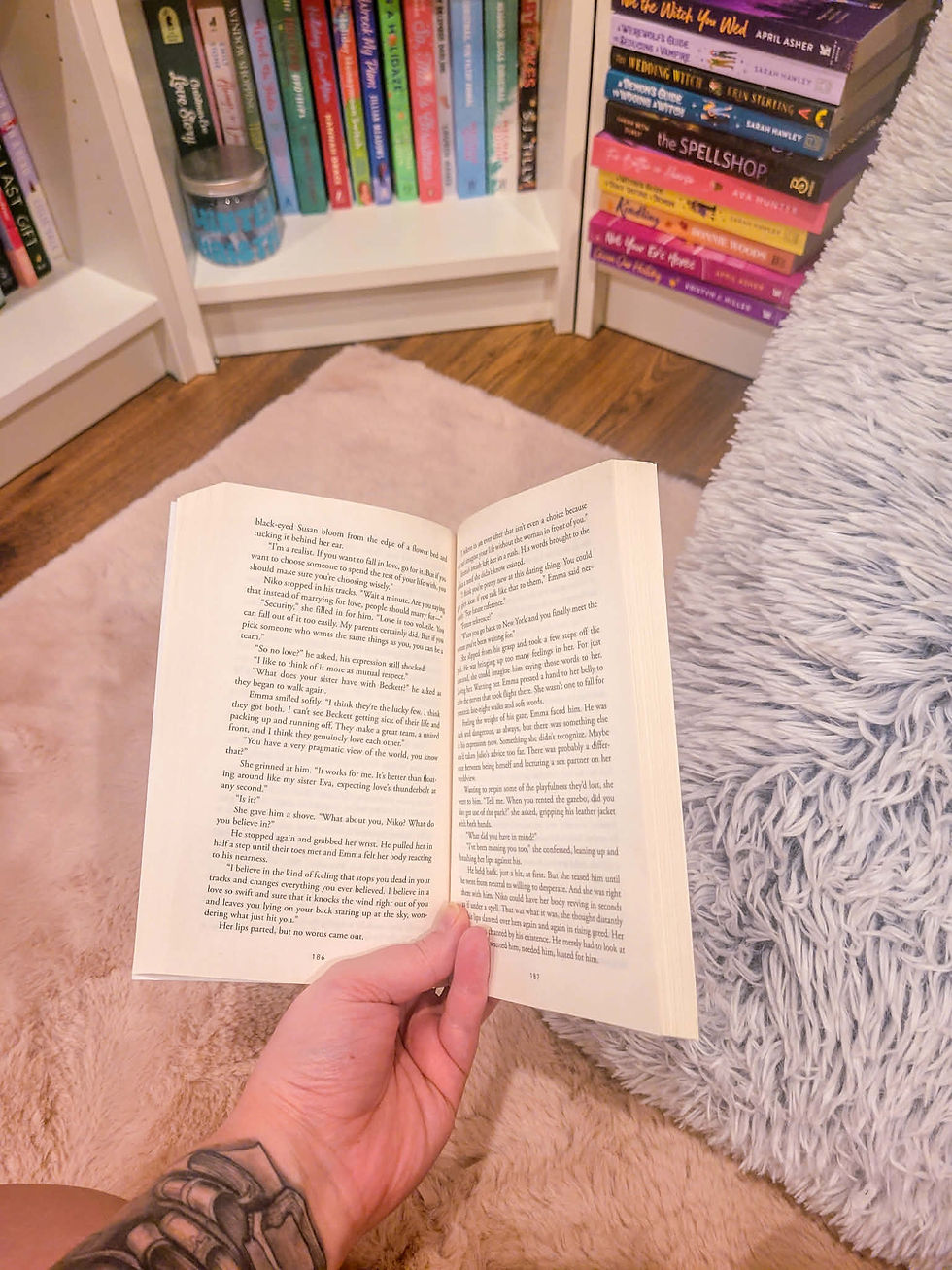
Most days, my reading happens in small pockets of time. At lunch, tucked into the middle of a busy workday. At night, in bed, when everything else is finally done. And more recently, I’ve been trying to spend more time in my book nook on the weekends — letting reading feel less like something I fit in, and more like something I settle into.
There’s usually something playing in the background. A playlist, or more often than not, an episode of Bones that I’ve seen enough times not to fully pay attention to. It’s not silence, but it’s still calm in its own way. Familiar. Comfortable.
And somewhere in all of that — in the routine, in the quiet, in the repetition — I realized something.
I wasn’t just reading stories.
I was participating in them.
And maybe that’s what this really is — the hidden art of everyday reading, something we practice without even realizing we’re creating at all.
Readers as Co-Creators
When we talk about books, we tend to focus on the author.
Their imagination. Their storytelling. Their ability to build entire worlds from nothing more than words on a page.
But reading has its own kind of creativity — one that exists in the space between what’s written and what’s experienced.
Because no two readers ever see the same story in quite the same way.
For me, that difference shows up most clearly in how I picture settings.
I can almost always see the characters. Their expressions, their movements, the way they interact with each other — that part comes easily. But the setting? That’s where things shift.
Sometimes it’s clear. Sometimes it’s vivid.
And sometimes… it’s blurred.
The setting is there, technically. I can tell what the author is describing. But it doesn’t fully settle into place. It feels slightly off, like something isn’t quite clicking, even if I can’t explain why.
And when that happens, I notice it. It becomes harder to fully sink into the story — not because the writing isn’t strong, but because my version of it hasn’t fully formed.
Other times, though, my imagination takes over without me even trying.
Small towns become softer, cozier, more familiar. The kind of places where everyone knows each other, where there’s an unspoken sense of community woven into the background of every scene.
And when books describe mountains or wide, open landscapes, my mind doesn’t create something new — it reaches for something I already know. Living near the Rockies has shaped that more than I realized at first. So when I read about mountain views, I’m not building them from scratch. I’m pulling from memory. From experience.
I’m layering my own world into the one on the page.
And that’s the hidden part of reading that we don’t always talk about.
It’s not passive.
It’s collaborative.
The Creative Rituals of Reading
Creativity in reading doesn’t always look like elaborate annotations or aesthetic systems.
Sometimes, it looks simple.
I don’t annotate heavily. I don’t draw — not even a little — and I’ve never really found a color-coding system that works for me. Most of the time, I stick to black ink. No complicated system. No perfectly curated spreads.
On the surface, it probably looks pretty basic.
But it doesn’t feel that way.
Because for me, the creativity isn’t in how it looks — it’s in what it holds.
Writing down quotes. Jotting small notes in the margins. Marking the lines that made me pause, even for just a second longer than the rest.
It gives me something to come back to.
Because reading doesn’t end when you finish the last page — at least, it doesn’t for me. Those notes become a way of revisiting what I loved, what stood out, and what made the story meaningful in that specific moment.

And rereading adds another layer to that.
There’s a kind of nostalgia in going back to a book you’ve already read, especially when your past thoughts are still there waiting for you. Sometimes my favorite quote changes. Sometimes I notice something completely different than I did the first time. And sometimes, it feels like I’m reading the story alongside a past version of myself.
It’s familiar, but not the same.
Like stepping into a memory that’s shifted slightly over time.
And then there are the rituals that exist outside the pages.
The seasonal habits. The cozy details. The small choices that shape how a story feels without changing the story itself.
These things aren’t necessary.
But they add texture.
They turn reading into something you experience, not just something you do.
For me, creating bookmarks became part of that experience in a way I didn’t expect. It started small — just playing around with my Cricut, making simple cuts and stickers, figuring things out as I went.
And then it grew.
Now, I love making printed bookmarks, and I’ve started experimenting with different ideas — like laminated designs with vinyl layered on top. Recently, I made one that looks like a movie ticket, and it’s quickly become one of my favorites. It’s small, but it feels creative in a way that connects directly back to reading.
It’s something I made, but also something I use.
And that connection makes the whole experience feel more personal.
More intentional.
More mine.
How Reading Expands the Way We Experience the World
Not every impact of reading is obvious.
Some of it happens quietly, in the background, without you really noticing it at first.

I wouldn’t say I’ve always been fully aware of how books shape the way I see things. It’s not always a clear moment of realization.
But when I stop and think about it, the influence is there.
Looking up foods that are mentioned in a story. Saving recipes I want to try someday. Letting a single detail lead me down a path of curiosity.
Adding places to a mental list — sometimes without even realizing I’m doing it.
Scotland and Ireland were already on my radar, but the more I read, the more they move higher and higher on that list. Stories have a way of doing that. They take something that already interests you and deepen it. Add layers to it. Make it feel more real, even from a distance.
And for me, that’s what reading often becomes.
A kind of armchair travel.
Not in a way that replaces real experiences, but in a way that still feels meaningful. Still feels like discovery. Like connection.
It’s about experiencing pieces of the world from where I am — through stories, through food, through curiosity.
And over time, those small moments start to shape the way you notice things.
Not in a dramatic way.
But in a quieter, more consistent one.
Readers as Quiet Artists
We don’t often think of readers as artists.
There’s no finished piece to display. No clear end result to share.
But that doesn’t mean the creativity isn’t there.
Because every time you imagine a setting in your own way, you’re creating something. Every time you adjust a detail to make it feel more real to you, you’re shaping the story into something personal.
Something that only exists because you experienced it that way.
For me, a lot of that comes back to the kinds of stories I’m drawn to in the first place.

Small towns. Nature-filled settings. The kind of places where there’s a sense of closeness — where people look out for each other, where community feels like an unspoken constant in the background.
There’s something about that kind of setting that pulls me in every time.
Maybe it’s the comfort of it. The familiarity. The idea of having that kind of closeness, that kind of connection. It’s not just about the story — it’s about the feeling behind it.
And reading lets me step into that, even if just for a little while.
Creating alongside that — whether it’s bookmarks, notes, or small rituals — only deepens that connection. It makes the experience feel more tangible. More grounded.
More mine.
And maybe that’s what this hidden art really is.
Not something you show.
But something you carry.
So maybe reading isn’t just a quiet hobby.
Maybe it’s a quiet form of art — the hidden art of everyday reading that lives in imagination, memory, and the small rituals we build around books.
One that lives in imagination, in memory, in small rituals, and in the way we choose to engage with the stories we love.
One that doesn’t need to be loud to be meaningful.
If you’ve never thought about your reading this way before, start small.
Choose one creative thing to do alongside your reading. It doesn’t have to be perfect or complicated. Make a bookmark. Write down a quote. Try annotating if that’s something you’ve been curious about.
Or simply let yourself be a little more immersed in the experience.
Because that’s where the art is.
I’d love to know — what’s one way you bring creativity into your reading life?

May your heart stay warm, your pages stay full, and I’ll meet you in the next chapter.


Comments