.png)
The Rise of Annotating

There’s a quiet shift happening in the reading world right now, and if you’ve spent any time in bookish corners of the internet, you’ve probably already seen it without even realizing what it was at first.
Books aren’t just being read anymore.
They’re being lived in.
Underlined. Highlighted. Scribbled in. Filled with sticky notes, tiny reactions, and little thoughts tucked into margins like conversations you’re having with the story itself. Annotating—something that for a long time felt mostly associated with classrooms, textbooks, and academic spaces—has become much more visible in everyday reading culture lately.
But the interesting thing is that annotating itself isn’t actually new.
Readers have always interacted with books. People have always underlined favourite passages, written thoughts in margins, or kept notes while reading. What’s really changed is how openly people talk about it now.
And honestly? I think that visibility has changed the reading experience in a really interesting way.
Annotating Was Always There

Annotating has existed for as long as people have been deeply engaging with books.
Students have always done it while studying. Academics have built entire conversations in the margins of texts. Readers have kept journals beside them while reading for years. Even older books sometimes carry traces of previous readers through little notes, folded pages, or underlined passages.
But outside of academic settings, annotating used to feel much more private.
For a long time, books were treated as things you were supposed to keep pristine. Clean pages. Unbroken spines. No marks, no scribbles, no signs that someone had deeply interacted with the story itself.
And because of that, a lot of readers kept their reactions separate from the books they loved.
The habits never disappeared.
They just weren’t talked about as openly.
The Shift: Reading Became More Visible
One of the biggest reasons annotating feels so prominent right now has less to do with annotating itself and more to do with how reading culture has changed online.
Reading used to be incredibly personal and mostly invisible. You read a book, maybe recommended it to a friend, and moved on.
Now reading is shared everywhere.
BookTok, Bookstagram, reading vlogs, blogs, reading journals, wrap-up videos—people don’t just share what they’re reading anymore. They share the experience of reading it.
And annotating naturally became part of that.
Readers started posting:
highlighted passages
emotional reactions in margins
sticky-tabbed fantasy books
annotated romance novels
notebook pages full of quotes and thoughts
Kindle highlights that completely wrecked them emotionally
What used to stay private suddenly became visible.
And because of that, annotating now feels far more present in everyday reading culture than it once did.
Why Annotating Fits This Reading Era So Well
There’s also something about annotating that fits especially well with how many people are trying to read right now.
We live in a world where everything moves quickly. We scroll constantly. We skim information. We move from one thing to the next without always sitting with it for very long.

Even reading can sometimes start to feel like that.
Finish the book. Add it to Goodreads. Start another one.
Annotating interrupts that rhythm a little.
It encourages readers to pause. To sit with a sentence longer. To react in real time instead of immediately moving forward.
It turns reading into something more active and intentional.
Not necessarily slower in a bad way—but slower in a more present way.
The Emotional Side of Annotating
A huge part of why annotating feels so visible right now is because readers are using it emotionally, not just academically.
People aren’t only highlighting “important” lines.
They’re marking the lines that made them feel something.
A sentence that hit too close to home. A quote that perfectly captured an emotion. A scene that made them stop reading for a second just to process it.
Annotating becomes a way of holding onto those moments.
And when people share those annotations online, it creates this really interesting sense of connection between readers. Someone else sees the exact same line highlighted and immediately understands why it mattered.
It makes reading feel a little less solitary.
Annotating as a Way of Slowing Down
I also think annotating is becoming more openly embraced because so many readers are craving slower, more intentional habits right now.
Not necessarily reading fewer books.
Just experiencing books more fully.
Annotating naturally encourages that because it asks you to stay with the story a little longer. To think about what’s standing out to you instead of rushing toward the ending.
And that can look different for everyone.
For some readers, that means detailed colour-coded systems. For others, it’s just one or two highlighted passages per book.
Neither approach is more “correct” than the other.
The Aesthetic Side of Annotating
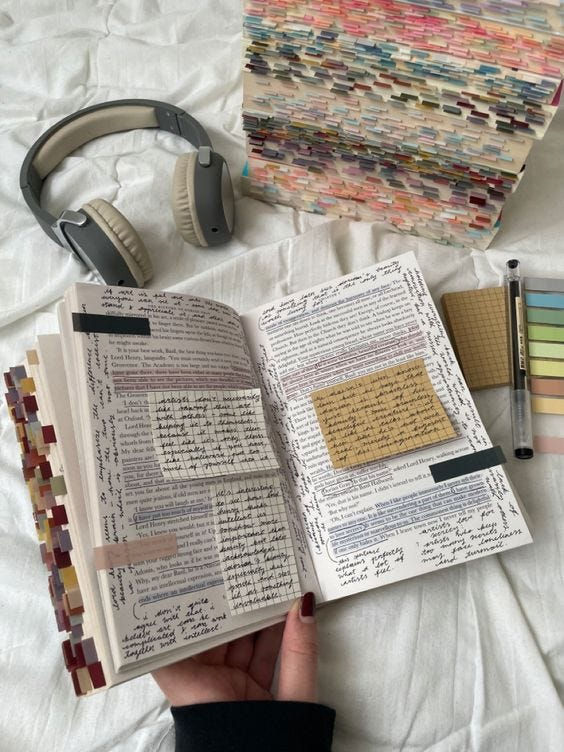
Of course, part of annotating’s visibility right now also comes from the visual side of it.
Annotated books photograph beautifully.
Sticky tabs peeking out from pages. Soft highlighter colours. Marginal notes layered between paragraphs. Books that visibly look loved and lived in.
And because reading culture is so visual online now, annotating naturally became part of that aesthetic language too.
But I don’t think it’s only about aesthetics.
There’s something genuinely meaningful about being able to physically see your reading experience reflected back at you through notes, highlights, and reactions.
The book becomes part story, part memory capsule.
My Relationship With Annotating (A Slightly Different One)
Personally, I don’t actually annotate in my physical books.
And it’s not because I don’t love the idea—I really do. I love seeing annotated copies. I love how personal they feel and how they show someone’s relationship with a story.
I just personally struggle with doing it in physical books myself.
There’s something about physical books that makes me want to keep them untouched. I like them staying exactly as they are, almost like preserving the story in its original form.
Kindle books are a little different for me though.
On Kindle, I’ll happily highlight passages I love or moments that stand out because it feels less intimidating somehow. Less permanent.
But my main form of annotating actually happens outside the book entirely.
I always keep a notebook with me when I read.
That’s where I write quotes, reactions, emotional moments, little thoughts, themes I notice, or anything else I want to remember later. Instead of writing inside the book, I write alongside it.
And honestly, I think that still counts completely.
Annotating doesn’t have to mean covering pages in ink. Sometimes it just means actively engaging with what you’re reading in whatever way feels natural to you.
Annotating Isn’t One Specific Thing
One of the things I love most about annotating becoming more openly discussed is that readers are realizing there’s no single “right” way to do it.
For some people:
annotating means heavily marked-up pages
for others, it means Kindle highlights
for others, it’s sticky tabs
and for readers like me, it’s notebooks sitting beside the book the entire time
All of those are valid.
Because at its core, annotating is really just about interaction.
It’s about responding to stories instead of simply consuming them.
Why Annotating Isn’t Going Anywhere
I don’t think annotating is just a temporary reading trend.
I think readers are simply becoming more comfortable sharing the ways they already connect with books.
And in a reading culture that can sometimes feel focused on productivity—how many books you read, how fast you finished them, what your yearly goal is—annotating offers something quieter.
It encourages presence.
It reminds readers to stay with stories a little longer instead of immediately moving onto the next thing.
And honestly, I think that’s part of why so many people are resonating with it right now.
Annotating isn’t really about making books aesthetic or academic.
And it’s not really about perfection either.
It’s about connection.
It’s about paying attention to what a story is doing to you while you’re reading it. Holding onto moments that mattered. Creating a small record of your experience with a book, whether that lives directly in the pages, inside Kindle highlights, or in a notebook sitting beside you.
Because reading isn’t just about finishing stories.
Sometimes it’s about leaving little pieces of yourself behind while you move through them too.
Do you annotate your books, or do you prefer keeping them clean and untouched? I’d genuinely love to hear what your reading style looks like.

May your heart stay warm, your pages stay full, and I’ll meet you in the next chapter. ✨


Comments